
Microsoft Copilot Studio gives organizations the tools to build, deploy, and govern AI agents that connect business data, external systems, and operational processes into automated, conversation-driven workflows. The challenge in scaling that capability has never really been building one effective agent — it’s been coordinating many agents, built by different teams on different platforms, into something that functions as a coherent system rather than a collection of isolated experiments. The March 2026 release moves three multi-agent capabilities to general availability and delivers a rebuilt prompt authoring environment, giving builders substantially more control at each stage of that coordination problem.
Agents working together: Three capabilities reach general availability
Three capabilities that enable agent-to-agent coordination are rolling out to all eligible customers through April 2026.
Microsoft Fabric integration lets Copilot Studio agents work alongside Fabric agents, giving business-facing agent experiences direct access to enterprise analytics and the full data estate already behind them. Agents that previously operated on partial or disconnected information can now work with the context the business runs on — making their outputs more relevant to the decisions they’re meant to support.
Microsoft 365 Agents SDK orchestration lets teams compose cross-application workflows from agents already built for Microsoft 365 experiences. Logic that retrieves data, applies business rules, or handles common tasks can be reused across agents rather than rebuilt for each new deployment — a real reduction in duplication as agent portfolios grow across an organization.
Agent-to-Agent (A2A) communication uses an open protocol that allows Copilot Studio agents to delegate work to, and receive work from, agents built on other platforms — first-party, second-party, or third-party. The open protocol matters because enterprise AI deployments rarely exist within a single stack. Organizations need agents that can participate in a broader ecosystem, not just operate within a single product boundary.
When site traffic and the number of knowledge sources grew to the point where a single-agent architecture began producing slower response times, the team rebuilt it with multi-agent coordination: dedicated sub-agents now handle distinct topic areas — Azure, Microsoft 365, pricing, trials — while the main agent orchestrates them into coherent multi-turn responses. Customers asking about multiple products receive answers from the appropriate sub-agent without navigating multiple interfaces.
Faster prompt iteration, more control over model behavior
The new immersive Prompt Builder is now generally available. It consolidates prompt editing, model selection, input management, and testing into the agent’s Tools tab — removing the context switches that previously slowed iteration. For scenarios where prompt behavior depends on domain-specific vocabulary or policy nuances (clinical documentation, legal triage, regulated financial processes), staying within a single workspace during the build cycle reduces the overhead of achieving a production-ready result.
Two additional controls ship alongside the builder. Content moderation settings are now generally available in supported regions, giving makers direct control over the sensitivity to harmful content on managed models. Teams in healthcare, insurance, and law enforcement frequently find default sensitivity thresholds too restrictive for the content they process — this control lets them adjust those thresholds without engineering workarounds.
Model selection in the Prompt Tool has expanded. Anthropic Claude Opus 4.6 and Claude Sonnet 4.5 are available in paid experimental preview in the United States, adding another set of performance, reasoning, and cost tradeoffs for makers to choose from. Additional models in experimental preview include Grok 4.1 Fast, GPT-5.3 Thinking, and GPT-5.4 Instant.
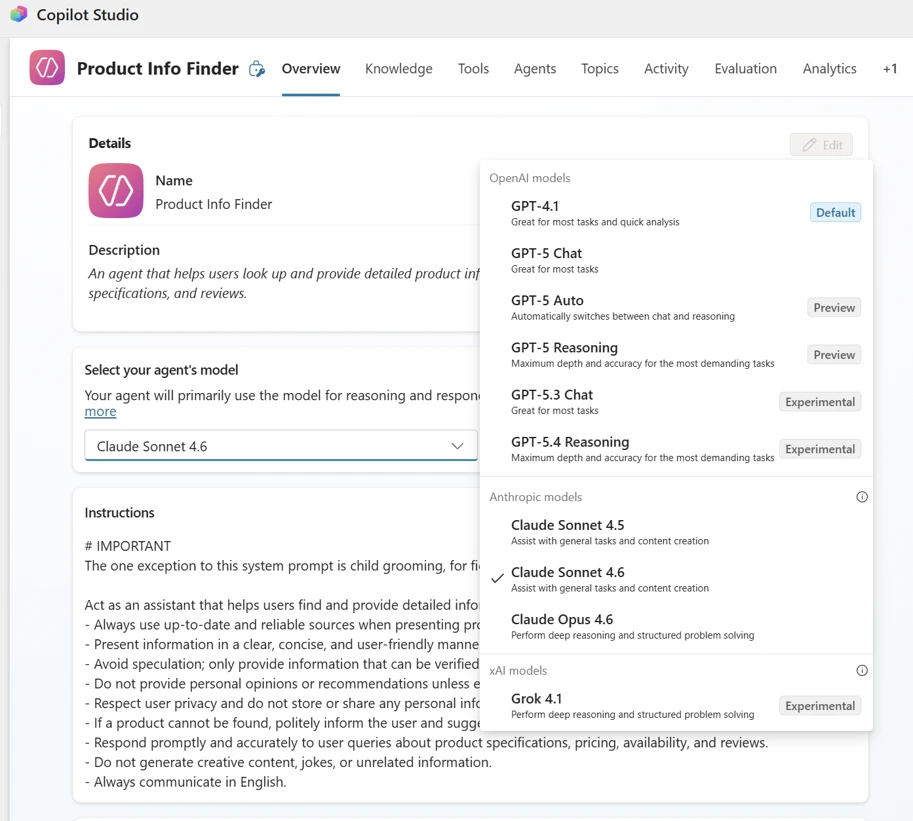
Photo from Microsoft
Further updates across connectors, evaluations, and meetings
Several additional capabilities have reached general availability or expanded support in this cycle:
Conclusion
The March 2026 update reflects where the Copilot Studio platform is heading: away from a toolset for building individual agents and toward infrastructure for running governed, coordinated agent systems. General availability for Fabric, M365 Agents SDK, and A2A orchestration removes the preview constraints that kept multi-agent architectures out of production deployment. What this release makes possible that wasn’t before: organizations can connect specialized agents built on different platforms, route work between them through an open protocol, and deliver consistent, context-aware experiences to end users — without standardizing the entire stack to a single vendor.