

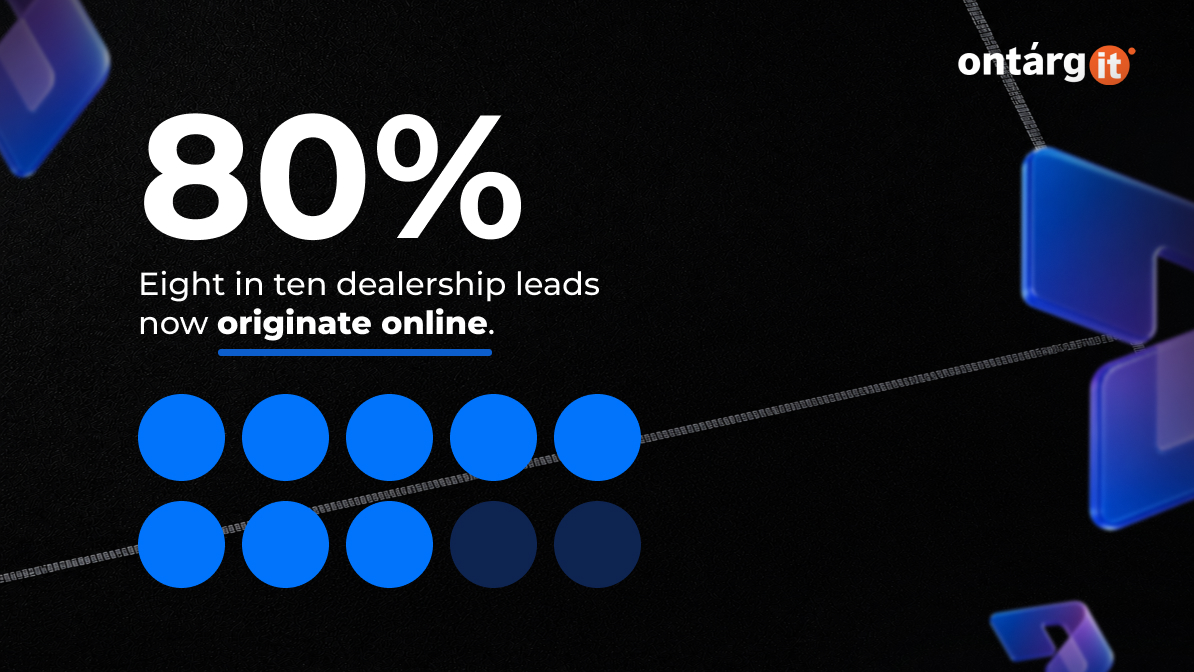
Eight in ten dealership leads now originate online (Boston Consulting Group, 2025), but most automotive distributors are still running the customer-facing side of their business through systems designed for a walk-in showroom era. The pressure to modernize is settled. The harder question is which path to take — and that question has three real answers, not one. Keep the legacy dealer management system and patch around it. Build a custom solution on Microsoft Dynamics 365. Or extend Dynamics 365 with a packaged automotive ISV.
The DMS modernization moment is here
The global dealer management system market is on track to nearly double — from USD 4.40 billion in 2025 to USD 8.26 billion by 2035 (Global Growth Insights, Automotive DMS Market Report, March 2026). That growth is not driven by dealers’ desire for more software. It is driven by dealers running out of road on the software they already have.
The system that handled walk-in customers, paper deal files, and overnight inventory reports is not the system that handles same-day digital quotes, manufacturer recall campaigns, and connected-vehicle service alerts. The gap between what the DMS does and what the business needs is no longer a strategic discussion. It has become a daily operational cost — visible in lost leads, delayed service appointments, and dealer managers running parallel spreadsheets to fill the holes.
What a modern automotive operating system actually needs
Before choosing a path forward, name what the destination has to look like. A modern automotive operating system has five non-negotiable capabilities.
- 1
Omnichannel CRM that follows the customer, not the channel. Test drives, online configurations, dealer visits, and post-purchase service all share one customer. The CRM has to as well.
- 2
Recall and service campaign automation. When a manufacturer issues a recall, the work to identify affected VINs, contact owners, schedule service, and track completion runs as configured in the workflow — not as a manually assembled project.
- 3
VIN-level cost allocation. Each vehicle carries its own freight, customs, insurance, and overhead. A financial dimension on every VIN means margin analysis at the unit level, not the model level.
- 4
OEM-to-dealer-to-customer data continuity. Bookings flow from the manufacturer portal to importer, dealer, and customer through one backbone — not five reconciled spreadsheets.
- 5
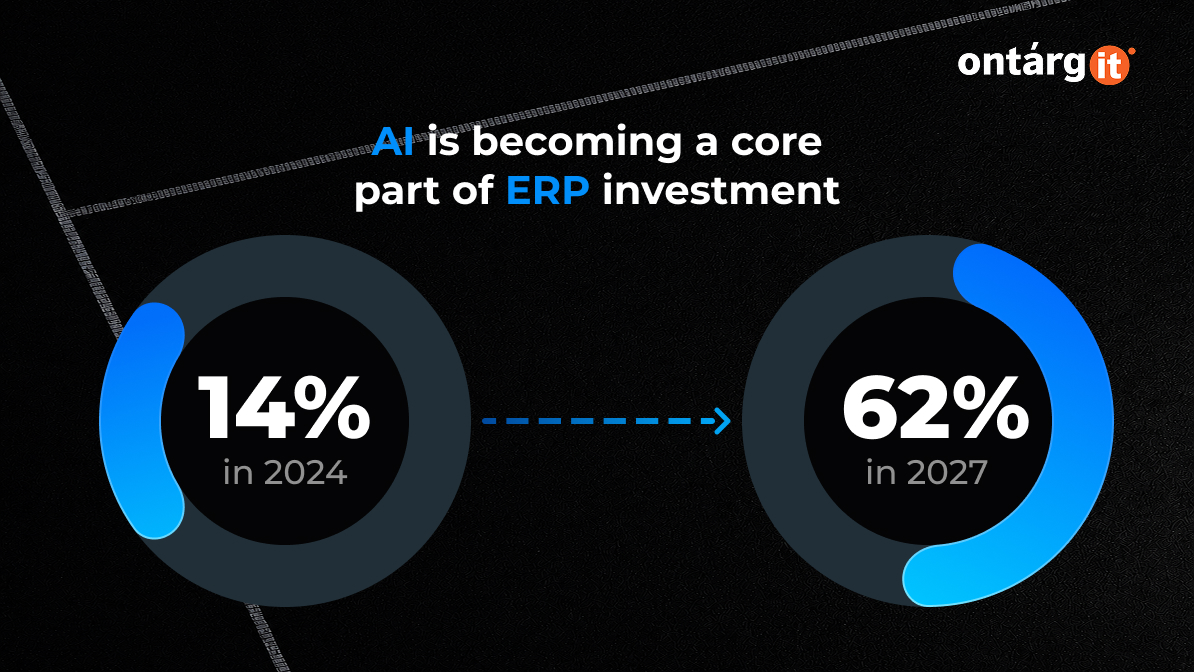
AI-assisted operations as part of the platform. Gartner forecasts that by 2027, 62% of ERP application spending will include AI capabilities, up from 14% in 2024 (Gartner Magic Quadrant for Cloud ERP for Service-Centric Enterprises, October 2025). For automotive, that means agentic supplier communications, intelligent service planning, and predictive parts demand.
Path one — keep the legacy DMS and patch around it
On paper, this is the cheapest path. No new licenses. No migration. No disruption to dealers who have been using the same screens for fifteen years.
The cost shows up elsewhere. Forty-one percent of dealers cite integration with existing systems as the primary barrier to adopting modern DMS capabilities (Global Growth Insights, Automotive DMS Market Report, March 2026). The barrier is not technical — it is architectural. The legacy DMS becomes the limiting factor for everything else the business wants to do. A modern customer portal, a manufacturer recall platform, and an AI assistant for service advisors — each requires building a custom bridge to a system that was not designed to be bridged.
Otherwise, the patching budget grows faster than a replacement budget would have — and delivers none of the new capabilities the business actually needs.
Path two — build a custom solution on Dynamics 365
This path appeals to organizations that want full control. Every workflow is tuned to the company’s exact way of working.
In practice, custom builds carry the worst risk profile in enterprise IT. A landmark McKinsey study of more than 5,400 large IT projects, conducted with the University of Oxford, found that large-scale projects run 45% over budget and 7% past schedule on average (McKinsey & University of Oxford, 2012).
The reason is concrete. A custom Dynamics 365 automotive build has to recreate capabilities the industry has already standardized — the data model for vehicles, deals, warranties, inspections, and test drives; the workflow for recall campaigns; the financial dimension structure for VIN-level costing; the dealer portal. Microsoft’s Automotive Accelerator publishes 91 entities for exactly this purpose, and most custom builds use it as their foundation anyway.
Custom development is the right answer when the business model is genuinely unprecedented, or when scale demands an architecture that no packaged solution addresses.
Path three — extend Dynamics 365 with a packaged automotive ISV
The third path keeps Microsoft Dynamics 365 as the platform and adds a packaged automotive ISV (independent software vendor) solution on top — covering the standardized capabilities the industry shares, configured where the business is genuinely distinct.
OntargIT IDMS is one example. It runs as two integrated layers: IDMS CRM on Microsoft Dynamics 365 Sales, Customer Service, and Field Service; and IDMS ERP on Dynamics 365 Finance, Supply Chain Management, and Human Resources. Together they cover the full automotive lifecycle — lead, test drive, sale, delivery, service, recall, parts — with VIN-level financial dimensions for unit-level margin analysis.
Production deployments include Toyota Ukraine, Toyota Motor Kazakhstan, Hyundai Motor Ukraine, Winner Imports (47 dealer centers across Ford, Volvo, Jaguar, Land Rover, Porsche, and Bentley), and MAN Truck & Bus Ukraine. The trade-off is honest: less bespoke than custom, faster than legacy migration, and constrained to capabilities the ISV covers.
How to make the decision
Two questions separate the right path from the comfortable one.
- 1
Does our business process genuinely diverge from industry standards, or does it just feel that way? Automotive importers and distributors run roughly the same lifecycle. The cases that justify a custom build are real but rare.
- 2
Can the chosen path inherit the platform’s roadmap without rework? Gartner forecasts that by 2027, 60% of customers replacing ERP will select software for its platform and orchestration capabilities, not just transactional functions (Gartner Magic Quadrant for Cloud ERP for Product-Centric Enterprises, October 2025).
The honest verdict: most distributors who think they need to build do not. Most who think they can keep patching cannot.
Conclusion
Patching legacy costs more every year and delivers less. Custom builds rebuild what the industry has already standardized. Extending a Gartner Leader–positioned platform with a proven automotive ISV concentrates the spend on what is genuinely different about your business — and inherits the platform’s roadmap automatically.