


A pharmaceutical distributor running Dynamics 365 Finance discovers during a routine compliance review that the same customer appears in three places: as a billing account in the ERP, as a contact record in the CRM, and as an entry in a legacy portal that no one has updated for 14 months. Each record carries a different consent flag. The auditor’s question — “What data do you hold on this person, and under what basis do you process it?” takes four days to answer. The answer is still not definitive.
That scenario is not unusual in regulated industries, and it is not primarily a compliance problem. It is a data architecture problem that compliance makes visible.
The Real Problem Is Fragmentation, Not the Regulation Itself
Regulated companies rarely fail compliance audits because the regulation is too strict. They fail because the customer data those regulations govern is scattered — across an ERP module that finance owns, a CRM instance the sales team configured three years ago, a legacy customer portal nobody has touched since the last IT project, and a collection of spreadsheets that customer service built to fill the gaps between them. Each of those systems holds a version of the customer record. Each version has its own consent flags, update timestamp, and definition of “customer”.
That fragmentation is the compliance problem. The World Economic Forum’s Global Cybersecurity Outlook 2025 — drawing on interviews with CISOs predominantly from large international organizations with elevated regulatory exposure — found that 76% of respondents report that regulatory fragmentation significantly affects their ability to maintain compliance. That figure reflects a particular segment of the market, not the average enterprise; for the companies it does represent, however, the finding confirms what fragmented data architectures make inevitable: regulatory complexity amplifies an existing problem in the data layer.
The financial exposure is concrete. The IBM Cost of a Data Breach Report 2024 recorded an average breach cost of $4.88 million, covering detection and escalation, notification, post-breach response, and lost business — including regulatory notification costs and associated legal expenses. Large one-off GDPR penalties of the kind issued to major platforms in 2024 typically fall outside the scope of any cross-industry average, meaning the true cost exposure for a regulated enterprise in the event of a significant incident is higher than the headline figure suggests.
What a Unified Customer Data Platform Actually Does in a Regulated Context
Dynamics 365 Customer Insights – Data is Microsoft’s customer data platform (CDP). It ingests transactional, behavioral, and demographic data from multiple source systems — CRM, ERP, e-commerce, external data providers — deduplicates it, and produces a unified profile for each customer. That profile becomes the single source of truth that compliance teams, auditors, and customer-facing operations all draw from.
The distinction that matters for regulated industries is where consent management sits in this architecture. In Customer Insights – Data, consent data is added during the unification process itself, with automatic data refresh — not managed in a separate tool and reconciled manually afterward. That means the unified profile carries the customer’s current consent state as a live attribute, not a static flag copied from a source system on the date of the last migration.
The operational benefit compounds the compliance benefit. The unified activity timeline — covering interactions recorded in Dynamics 365 Sales, Customer Service, and Customer Insights – Journeys — is visible in a single view within a shared Dataverse environment. A service agent handling a complaint, a sales representative preparing a renewal, and a marketing team building a segment all see the same customer record, updated in real time. In regulated industries, where a customer interaction in one channel can trigger disclosure obligations in another, that shared visibility is not a convenience — it is a control.
Governance Is Built Into the Architecture, Not Added On Top
The governance layer in Microsoft Dataverse addresses three categories of requirements that regulated enterprises encounter consistently: encryption, access control, and data residency.
On encryption, all Dataverse environments use SQL Server Transparent Data Encryption (TDE) for data written to disk. For organizations in sectors where key custody is itself a compliance requirement — pharmaceutical companies managing clinical trial data, energy operators managing national infrastructure data — Dataverse supports customer-managed encryption keys held in Microsoft Azure Key Vault, giving the organization full control over who can decrypt the data and under what conditions.
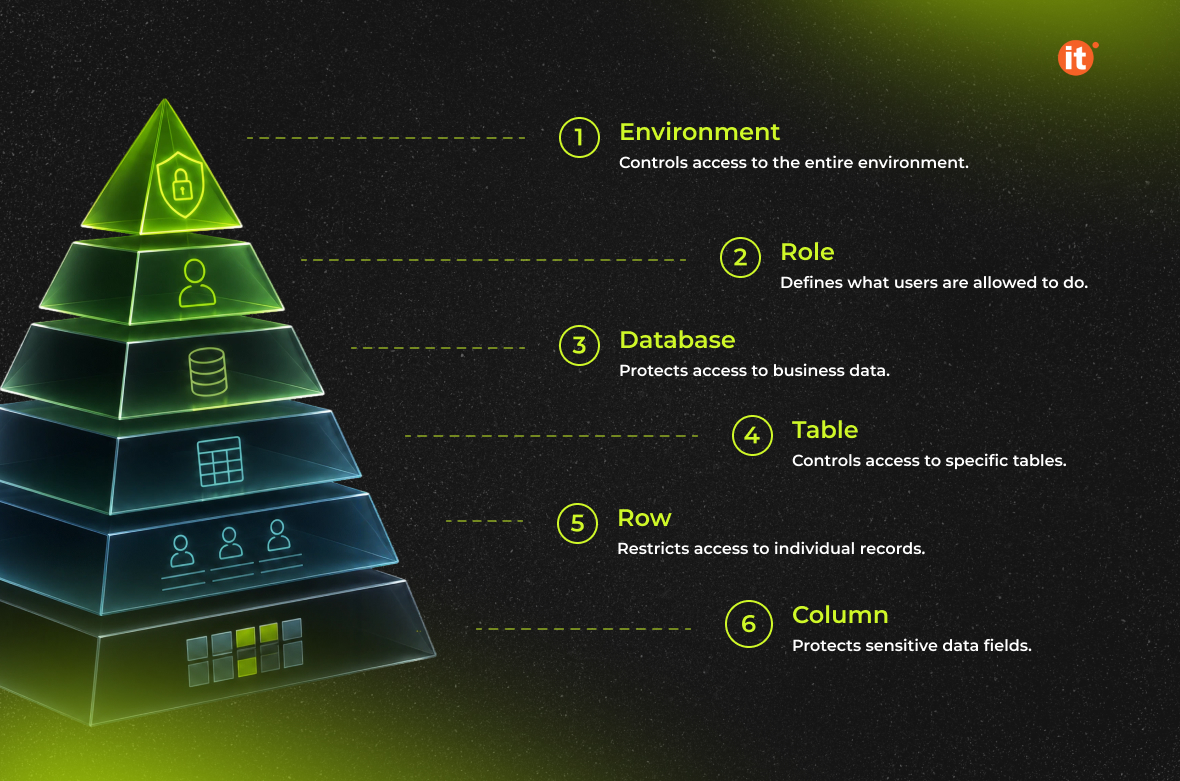
Access control in Dataverse operates at six levels: environment, role, database, table, row, and column. A service agent in one country can be restricted to records for customers in that jurisdiction at the row level, while a regional compliance officer can see the full dataset across markets at the role level. The principle of minimum required access is built into the predefined security roles — organizations do not start from a blank permission model.
Data residency is managed through multi-geo deployments, which allow each Dataverse environment to store data in a specific Azure geography to satisfy local data-localization requirements. Power Platform Data Loss Prevention (DLP) policies complement this by controlling which connectors can communicate with each other — preventing customer data from moving between environments or to external systems outside the approved boundary. For organizations operating simultaneously across the EU, Central Asia, or North America, this combination of a multi-geo configuration and a DLP policy is the practical mechanism for managing cross-border obligations.
The Business Case Alongside the Compliance Case
The argument for data unification in regulated industries is usually framed as risk reduction. A Forrester Consulting Total Economic Impact™ study of Dynamics 365 Customer Insights (April 2024, commissioned by Microsoft) reframes it as value creation: organizations in the study achieved a 324% ROI over three years, with a payback period of under six months. Marketers reported 75% time savings on customer journey development — time previously spent reconciling records from disconnected sources before a segment could be built or a campaign could run.
That time saving has a specific meaning in a regulated context. A pharma company preparing a product recall communication, an energy operator notifying customers of a service interruption, or an automotive importer managing a warranty campaign all face the same operational bottleneck: the customer list is only as reliable as the least-current source system feeding it. When the unified profile is the source of record, the communication reaches the right people with the right consent state, the first time.