

A three-week vessel delay is never just a shipping problem. It becomes a parts shortage across forty dealers, a revised promise date for every customer already holding a signed contract, and a margin number nobody can recalculate until the month closes. Importers rarely lose control of the shipment. They lose control of what the shipment means. Resilience in vehicle distribution comes from one structural condition — vehicle, part, cost and transport records sharing a single spine. Four capabilities decide whether an automotive ERP holds that spine together, and one design decision inside them usually gets made too late.
Where the automotive data spine breaks
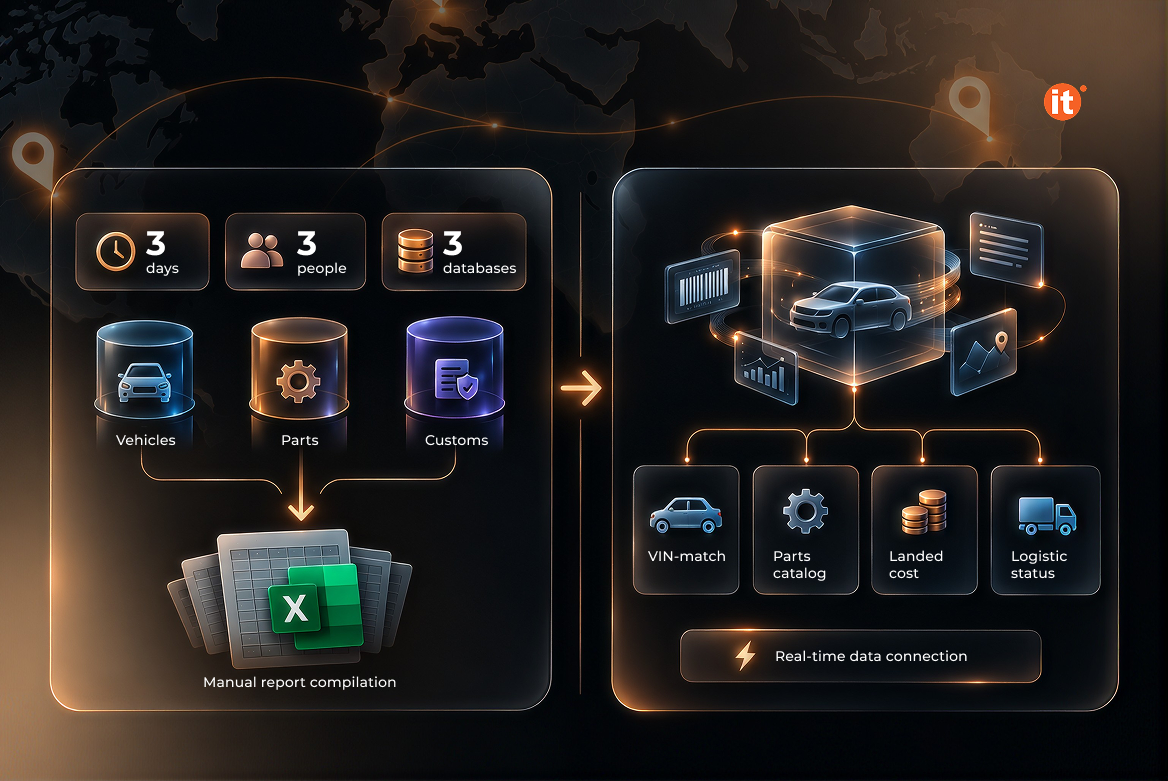
Ask the finance director at a vehicle importer what a three-week vessel delay actually costs, and the answer takes days to assemble. Someone exports vehicle records from one system, someone else pulls parts stock from a second, and a third person rebuilds duty and freight in a spreadsheet. Each of those systems was a defensible purchase at the time. Together they mean the company cannot answer one operational question with one query.
That fragmentation is the real subject of most automotive ERP projects, even when the brief is written in the language of modules and licences. McKinsey’s 2025 survey of 100 supply chain leaders found that most companies understand their supply chain risk only as far as their tier-one vendors, and that awareness at tier two and beyond fell across 2023 and 2024 without recovering to 2022 levels (McKinsey & Company, Decoding disruption to reshape manufacturing footprints, January 2026). The same research records something more awkward for anyone scoping a system right now: visibility work is losing internal funding to larger technology programmes, ERP replacement among them. Supply chain resilience tends to lose the budget argument to the project meant to deliver it.
One inventory position, not five
The same part number sits in three places at once and gets counted three separate times — on a shelf in the central warehouse, on a vessel between ports, and across the dealer network. Most importers reconcile those views weekly, so the number a parts manager works from is always several days old.
Inventory Visibility in Dynamics 365 Supply Chain Management holds a single on-hand position across data sources instead. It tracks status by state — on-hand, ordered, purchased, in-transit, returned, quarantined — and accepts feeds from Supply Chain Management alongside third-party ERP, point-of-sale and warehouse systems. That last point matters more than it sounds, because parts of a dealer network almost always run software the importer does not control and cannot replace.
OntargIT IDMS extends the same principle into the commercial layer. Its dealer workspace exposes prices, availability and order status to each dealer directly, and supports vehicle exchange between dealers rather than routing every reallocation through the importer’s head office. A dealer who can see real stock stops phoning to ask about it.
Planning that runs on today’s numbers
Planning Optimization is the master planning engine for Dynamics 365 Supply Chain Management, licensed within the standard Supply Chain Management licence at no additional cost, and Microsoft has deprecated the built-in engine it replaced. The practical difference is timing. Planning calculations run outside the application’s SQL database, which means planners can execute them during office hours instead of queuing for a nightly batch window.
For an importer that changes what happens when a shipment slips. Instead of logging the change and learning its consequences the next morning, the planner reruns the plan and sees which dealer commitments are now exposed before the day ends. Shortening that interval from overnight to minutes is what supply chain resilience looks like in daily practice.
Forecasting deserves a separate note, because buyers are frequently quoted one product and shown another. Demand planning is Microsoft’s next-generation collaborative demand planning application, and it is distinct from the older Demand forecasting capability built into the application — Microsoft now recommends the former. IDMS layers parts forecasting with machine learning and safety stock calculation on top of it.
Cost that follows the vehicle
Landed cost defines each inbound shipment as a voyage and tracks it leg by leg, from the supplier’s warehouse through freight forwarder and landing dock to the destination warehouse. Costs allocate down to item level through configurable allocation rules. Goods can be invoiced under goods-in-transit ownership before physical receipt, which is how most international trade terms already work — the accounting simply catches up with the commercial reality.
OntargIT IDMS carries that down to the individual unit by using the VIN or serial number as a financial dimension, then allocating delivery, duties, insurance, risk and quality-control overhead against specific vehicles. Financial dimensions are stored alongside the main account on every general ledger transaction in Dynamics 365 Finance, so margin per VIN becomes a reportable fact rather than a month-end reconstruction.
One caution belongs here, because a significant automotive ERP design decision hides inside it. VIN is a high-cardinality dimension — thousands of values, growing every month — and Microsoft treats cardinality explicitly as a design consideration within the dimension framework. Size it with a solution architect before the account structure is committed, not after.
OntargIT built IDMS on Dynamics 365 for vehicle importers and dealer groups. Winner Imports distributes Ford, Volvo, Jaguar, Land Rover, Porsche and Bentley across 47 dealer centres on Dynamics 365 Finance, Supply Chain Management, IDMS and the Ukrainian localization; Toyota Ukraine runs Toyota and Lexus across 35+ dealer centres; MAN Truck & Bus Ukraine runs IDMS alongside finance, distribution and dealer management.
Conclusion
Before comparing feature lists, run one test against your current systems. Pick a VIN that arrived late last quarter and try to assemble its landed cost, its dealer allocation and the parts orders it triggered — in a single query. If that takes a day and three people, the gap is structural, and another reporting tool will not close it. OntargIT’s automotive team can run the same test against your data.