
A UK plant that machines components, blends coatings, and builds custom assemblies to order runs three production logics under one roof. Its ERP has to know about all three before the first order is released. Most of the choices that shape an advanced manufacturing ERP — how each product is supplied, how cost is captured, and what gets traced — are made in the first design workshops. This guide sets out those choices in Microsoft Dynamics 365 and the order in which manufacturers should settle them. For the wider industry view, see our manufacturing ERP page.
Why UK advanced manufacturers rarely run a single production mode
A typical advanced manufacturing business does not fit one production logic. One line machines and assembles components in discrete units. Another blends resins or coatings in batches, where yield and co-products matter more than part counts. A third builds equipment to a customer’s specification, and the engineering only exists once the contract is signed.
Microsoft Dynamics 365 Supply Chain Management supports four modes of manufacturing — discrete, process, lean, and projects-based — and companies can combine them as their operations require. Combining them in one system is the easy part. When an advanced manufacturing ERP has to carry several production logics at once, the work that decides the outcome happens in design: which mode each product follows, how cost is captured, and how traceability is recorded. Mixed-mode manufacturing is an architecture choice made at implementation time.
Production type: the setting that decides what you can build later
Every manufactured item in Dynamics 365 Supply Chain Management carries a production type, and that setting determines which order types can supply it. Microsoft’s guidance on mixed mode planning recommends the BOM production type for all products where full flexibility is the goal, because a BOM item can be supplied by production orders, kanbans, transfer orders, or purchase orders. Process items work differently. They use the Formula, Co-product, By-product, or Planning item types, and neither kanbans nor production orders can be used for them.
For a UK plant running both assembly and batch processes, this is the first design decision. Classify a blended coating as a BOM item and it sits outside the process types that batch production relies on; classify a machined part as a formula and it can no longer be replenished by kanban. The second decision is coverage dimensions. Microsoft recommends enabling Site and Warehouse so master planning can separate supply for different production units and storage areas.
Production costing has to be designed before the first order
Microsoft’s implementation guidance is direct: define production costing up front, at the start of a Dynamics 365 Supply Chain Management implementation. Costing strategies can change as the business evolves, but many decisions must be made early because they shape the rest of the plan-to-produce process. The cost base normally covers four groups: direct material, resource or direct labour, subcontracting, and indirect or overhead costs. Some manufacturers track all four, while others track only materials when material dominates total cost.
The method matters as much as the scope. With standard costing, finance teams can analyse variances because cost changes are tracked in the general ledger. Those variances also expose data problems. A consistent variance on one route step suggests the route itself is wrong, and correcting it improves schedule accuracy and on-time-in-full performance. Production costing gives finance and engineering a shared test of the master data inside an advanced manufacturing ERP.
Engineer-to-order work sits between production and projects
Engineer-to-order adds a third structure to mixed-mode manufacturing: the project. Microsoft’s process guidance places job shop and engineer-to-order strategies in a project-led flow, where the project defines the scope and activities that drive production, and organisations update project status based on production activity.
In Dynamics 365 Finance, project production orders connect manufacturing to the project’s timelines, budgets, and deliverables. A project production order can be linked to a sales order or item requirement, or created directly. With the finished item posting method, the production order runs to completion, the cost of the finished item posts to the project, and the item can be invoiced to the customer. The design question is where production cost should land, in inventory or on the project, and the answer changes reporting for finance and operations alike.
Traceability and quality belong in the same data model
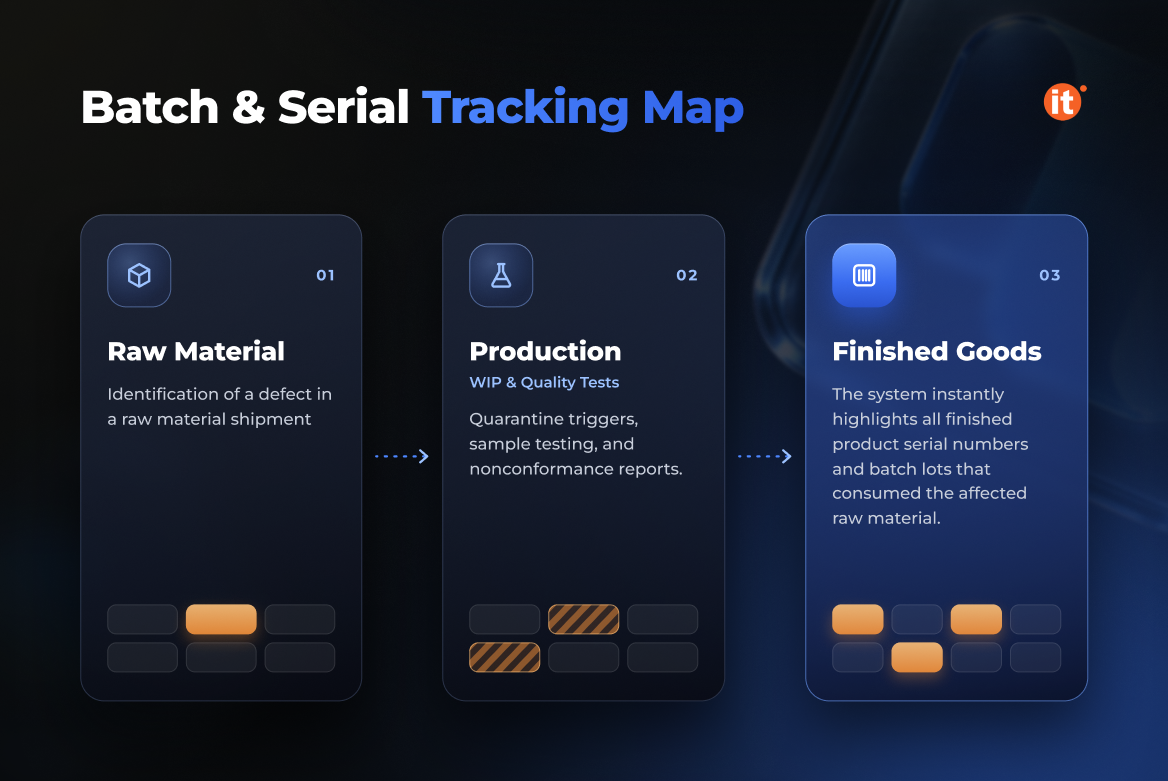
Raw materials, work-in-progress items, and finished goods can all be batch tracked, serial tracked, or both in Dynamics 365 Supply Chain Management. That record lets a quality team follow one faulty batch of material into every assembly that consumed it.
Quality management runs on the same data. Teams define the quality tests to perform, validate results, and record corrective actions and nonconformance reports, while the inventory side handles quarantine and sample quantities. Batch and serial tracking requirements belong in product design workshops, not in the month before the first customer audit.
The UK finance layer closes the loop
Production cost becomes useful only when it reaches the ledger in a form finance can report on. For UK entities, Dynamics 365 Finance handles Making Tax Digital for VAT by submitting VAT returns to the HMRC web service through a direct system-to-system integration. Production postings and VAT returns then come from the same general ledger instead of separate systems. Microsoft is recognised as a Leader in the Gartner® Magic Quadrant™ for cloud ERP systems (2025).
How OntargIT supports UK manufacturers
OntargIT has implemented Dynamics 365 for manufacturers whose cost picture spans several countries and production processes, including Fischer-Mukachevo, Abriso, a film manufacturer operating in six countries, and Mayr-Melnhof Karton. In the UK, OntargIT has delivered 17 joint projects with Dynamics 365 consultancy Inciper Limited, including manufacturing engagements. A Microsoft partner since 2009 and a Microsoft Solutions Partner – AI Business Solutions, with 150+ projects for 140+ clients in 24 countries, OntargIT runs ERP implementation from production design through go-live.
Settle the design before you sign the scope
The decisions that shape an advanced manufacturing ERP come early: which production type each item carries, how production costing is structured, where engineer-to-order cost lands, and which items are batch- or serial-tracked. Each one is simplest to settle in a design workshop, before orders, cost history, and inventory transactions depend on it. Test your product range against these four questions before you sign an implementation scope.