
Every one of the 15 statistical regions in Latvia and Lithuania is projected to lose population by 2050, most of them by at least 15% (Eurostat, Population projections at regional level, 2026). That is not a hiring problem a better recruiter solves. It is the pool itself contracting on a published schedule, which means output per employee rises or output falls. Agents built in Microsoft Copilot Studio are one practical response, but only where the underlying process already works — an agent on top of a broken shift handover just produces confident nonsense faster. Three plant-floor processes earn an agent first, and the governance decision has to land before the second one exists.
The labour pool contracts on a schedule
Baltic manufacturers are not short of workers today. The EU job vacancy rate in industry and construction was 1.8% in the first quarter of 2026 (Eurostat, Job vacancy statistics, Q1 2026), so a plant manager in Kaunas or Tartu is not staring at a wall of unfilled roles this morning.
The problem is scheduled rather than current. Eurostat’s EUROPOP2025 regional projections put every one of the 15 NUTS 3 regions in Latvia and Lithuania on a path to lose population between 2025 and 2050, most of them by at least 15% (Eurostat, Population projections at regional level, 2026). In Estonia, all but one region shrinks by at least 10%. The Baltic States sit among the 13 EU countries where that decline is driven by negative natural change — more deaths than births — and in these projections, migration does not close the gap.
That changes what a capacity plan has to look like. Across EU regions the old-age dependency ratio rises from 37.6% in 2025 to 54.5% by 2050 (same source), so the pool of working-age people a plant recruits from contracts while the claims on it grow. A factory planning to do more in 2032 with proportionally more people is planning against its own demographics. Manufacturing AI agents are one of the few levers that add administrative capacity without adding headcount.
What a Copilot Studio agent is now
If your mental model of agent building dates from 2024, it is out of date. Microsoft Copilot Studio now organises work into three building blocks: agents that handle conversations and complete tasks, workflows built in a drag-and-drop designer where each step can reason and act, and agent flows, the established format with an authoring experience close to Power Automate (Microsoft Learn, Copilot Studio overview).
Underneath all three sits a harness — the engine that carries out the work. The GitHub Copilot harness handles reasoning-heavy, multi-step processes, where you describe the goal in natural language instead of authoring topics and branching logic. The standard harness runs rule-based agents and structured, repeatable conversations, and predictable behaviour is exactly its point. The third, the Copilot chat harness, extends Microsoft 365 Copilot Chat with your organisation’s knowledge.
The choice is not cosmetic. It sets how complex a task the agent can take on and how the work is billed: agents and workflows on the GitHub Copilot harness consume Copilot Credits, while the standard and chat harnesses use seat licensing. For a plant costing out its first build, that is a budgeting decision as much as a technical one.
Three jobs on the plant floor worth an agent
Start where people retype what someone else already wrote.
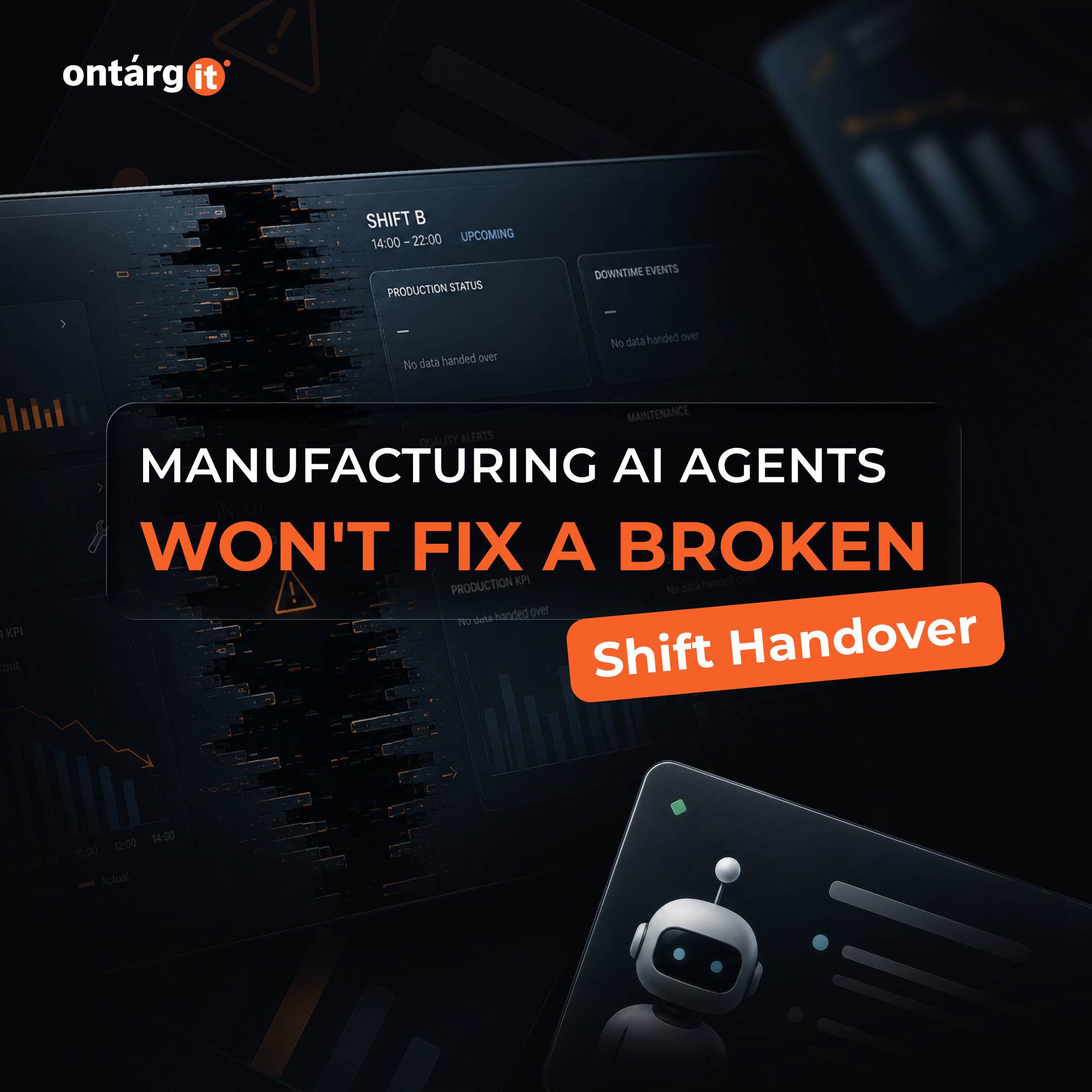
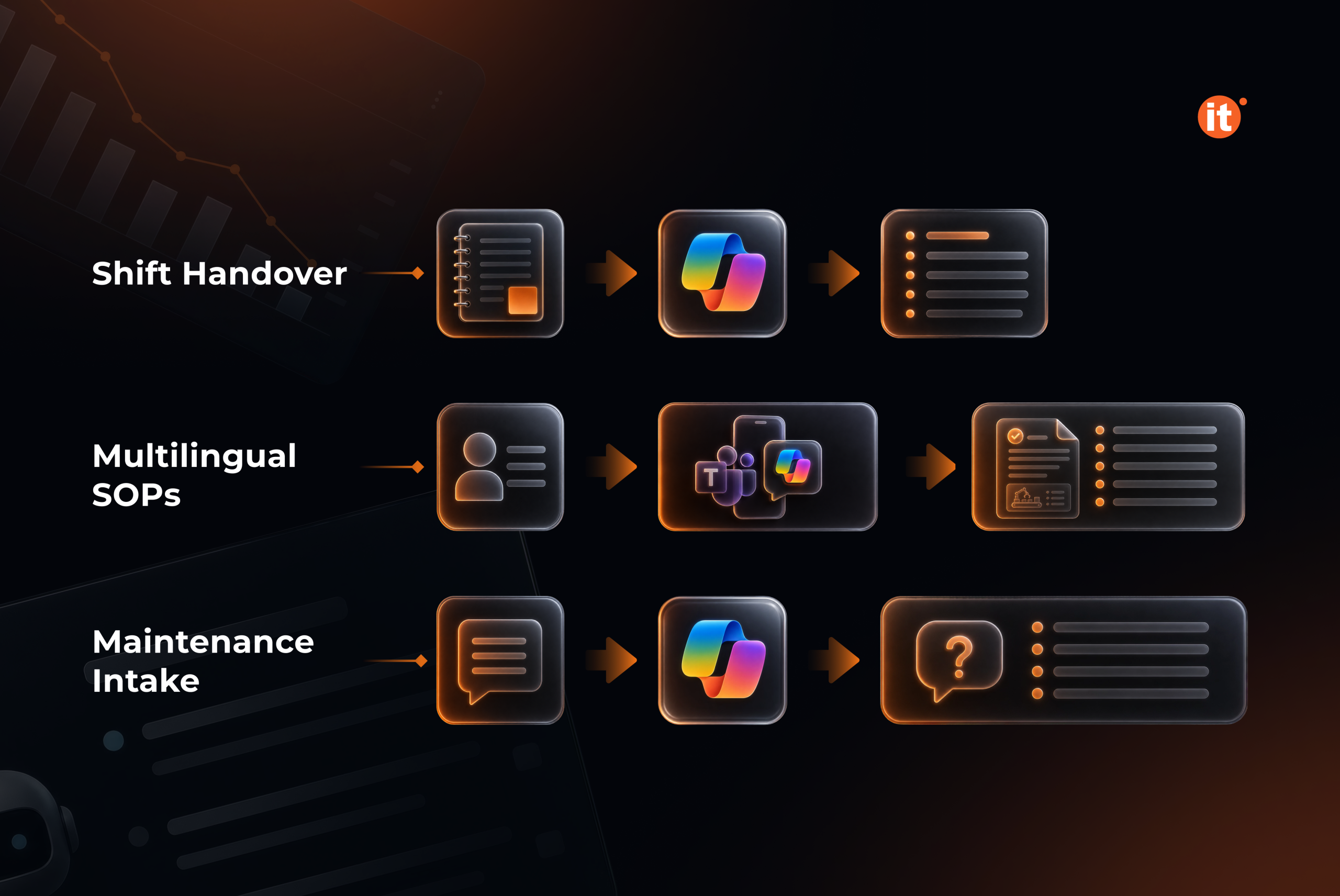
Shift handover is the clearest case. An outgoing supervisor’s notes — a jammed labeller, a pallet held for inspection, an operator sent home early — usually live in a notebook or a messaging thread, and the incoming shift reconstructs them from memory. An agent that takes those notes and returns a structured summary against the same fields every time removes the reconstruction, not the judgement.
Second is multilingual retrieval of specs and procedures. A Baltic plant floor can run Estonian, Latvian or Lithuanian alongside Russian, Polish and Ukrainian in the same building, and the standard operating procedure was written in exactly one of them. Copilot Studio agents work with employees in multiple languages across Teams, websites and mobile apps (Microsoft Learn, Agents overview), so an operator can ask in the language they think in and get the current revision instead of a laminated copy that is two revisions old.
Third is maintenance and quality request intake. A technician describing a fault in free text produces a ticket that someone else then has to classify, route and enrich before any work starts. An agent can capture the description, ask the two or three questions that make it actionable, and file it with the fields already populated.
None of these ships prebuilt. Each one is a build — which is what a low-code studio is for.
Agent governance before the second agent
The failure mode is rarely one bad agent. It is twelve of them, built by different teams, wired to different data, owned by nobody in particular.
Agent governance in Microsoft Copilot Studio runs on controls Power Platform administrators already operate. Data loss prevention policies and role-based access are enforced at the environment level, admins control which connectors an agent may reach, and application lifecycle management moves work across development, test and production rather than editing something live (Microsoft Learn, Copilot Studio security and governance). Geographic data residency is documented — usually the first question a European manufacturer asks before an agent touches production data.
Microsoft Agent 365 adds a central control plane for observing and securing agents, and organisations that onboard it can have Copilot Studio agents represented as identities in Microsoft Entra. An agent with an identity can be permissioned, audited and revoked like any other account. Settle the agent governance model before the second agent exists, because retrofitting one across twelve is a project nobody budgets for.
What agents will not fix
An agent sitting on top of a broken process automates the breakage at higher speed. If handover notes are unreliable because nobody has time to write them properly, summarising them faster produces confident nonsense.
Agents also need something to read. A plant that keeps maintenance history in a supervisor’s head and quality results on paper will find that an agent grounded in nothing returns answers grounded in nothing. The data work comes first, and it is the least glamorous part of any agent programme.
Be honest about which capacity this buys. Manufacturing AI agents give back administrative hours — the retyping, the classifying, the chasing — and they add no machine capacity at all. No line runs faster because a handover summary was written by software. For Baltic manufacturers facing a labour pool that shrinks on a published schedule, those administrative hours are still worth reclaiming, because they currently come out of people who will be hard to replace.
OntargIT has delivered Dynamics 365 and Power Platform projects for manufacturers including Mayr-Melnhof Karton, one of the world’s largest cartonboard producers, and Abriso, which runs polyethylene and polystyrene film operations across six European countries
As a Microsoft Solutions Partner for Business Applications since 2009 with 150+ delivered projects, OntargIT holds Qualified Delivery Partner status for the Copilot Studio Agent in a Day workshop, an eight-hour session that ends with a working agent prototype built by the participant.
Conclusion
The demographic projections will not reverse inside a planning cycle, so the question worth asking is narrower than whether to adopt AI: which process in your plant has people retyping what a colleague already wrote? Point the first agent there, on the harness that fits the work, with the environment and DLP decisions made before you build rather than after. Book a free consultation to map your candidate processes and settle the governance model in the same session.