
The proliferation of sophisticated agentic AI capabilities is rapidly reshaping the enterprise landscape, moving beyond simple automation to enable autonomous, goal-driven execution of complex business processes. However, leveraging this potential on a scale requires more than just technical deployment; it demands holistic organizational preparation.

Microsoft survey identifies four types of AI maturity

  • Achievers (High Strategy, High Execution): These leaders are performing well across all five readiness pillars.

  • Visionaries (High Strategy, Low Execution): Excelling in strategic thinking but weaker in execution pillars.

  • Operators (Low Strategy, High Execution): Perform well on execution-focused areas but score lower on strategic alignment.

  • Discoverers (Low Strategy, Low Execution): Consistently report the lowest readiness levels across all pillars.

To assess organizational readiness, 500 decision-makers and influencers across 13 countries and 16 industries self-evaluate by answering 25 questions grouped into five main pillars.

Five areas of readiness for the AI agent

Microsoft divided all pillars into two: strategic (including Business & AI Strategy and Business Process Mapping) and execution (Technology & Data, Org Readiness & Culture, Security & Governance).

The following sub-items were the theme of the 25 self-evaluating questions, with each column representing one pillow.
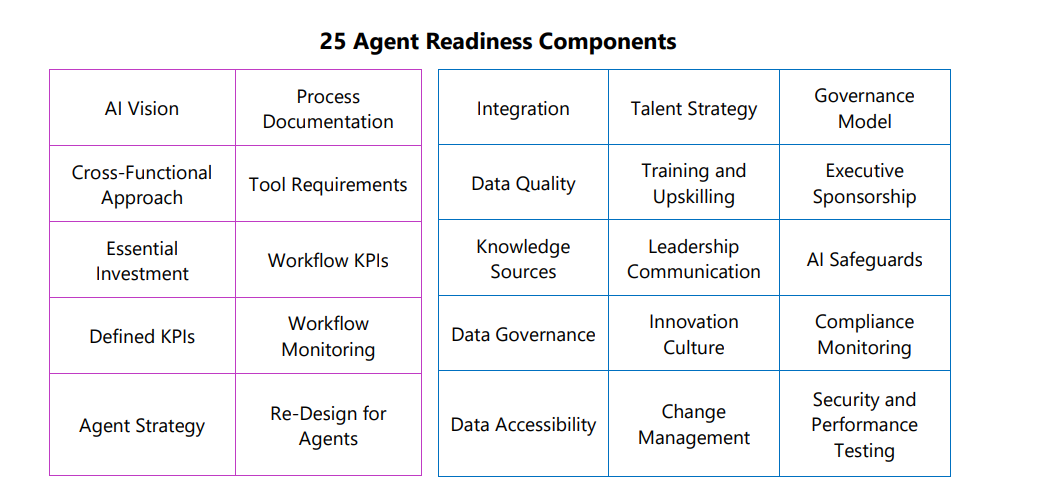
25 agent readiness components

picture from Microsoft whitepaper

Pillar One: Business and AI Strategy

This initial pillar stresses that every initiative involving agentic AI must originate from specific strategic business objectives and quantifiable key performance indicators for the organization.

Key Practices:

  • Connect initiatives for agents to corporate KPIs, focusing on achieving revenue growth or cost savings, as part of an enterprise-wide roadmap for AI/agent technologies.

  • Funding should prioritize use cases that are critical to the business and measurable, employing standardized frameworks to gauge Return on Investment.

  • Form an AI/Agentic Center of Excellence that is cross-functional to oversee and magnify impact across the enterprise.

  • Put in place a responsible AI framework and embed risk-management practices (such as human-oversight guardrails and auditing mechanisms) throughout the complete lifecycle of every agent.

Pillar Two: Business Process Mapping

The ultimate effectiveness of an AI agent is inherently constrained by the quality and precision of the business process it is programmed to execute.

Key Practices:

  • Concentrate on high-volume, high-value workflows, thoroughly documenting each step, dependency, and rule.

  • Document the process’s underlying rationale, including desired goals, SLAs, and compliance requirements, to help agents align with corporate objectives.

  • Treat documentation as a dynamic asset, continuously updating processes based on performance data and received feedback.

Pillar Three: Technology and Data

This pillar addresses the need for a strong technical and data foundation to enable the scalable, enterprise-wide deployment of agents.

Key Practices:

  • Consolidate AI capabilities onto centralized enterprise platforms to enable secure development, governance, reuse, and scaling.

  • Construct modular, API-first architectures that allow agents to interact across diverse applications and systems seamlessly.

  • Implement a data fabric or lakehouse structure to guarantee that both structured and unstructured data are consistent, synchronized, and readily available for AI applications.

  • Establish clear ownership and defined refresh schedules for datasets

Pillar Four: Organizational Readiness and Culture

Organizational preparedness and culture are essential for realizing the full advantages of AI, as people, not merely agents, are the driving force behind transformation.

Key Practices:

  • Clearly communicate how agents will support employees and contribute to the business.

  • Recognize and reward pioneers who responsibly create new workflows and share effective methods.

  • Invest in structured training and upskilling programs to expand agentic AI proficiency across the entire workforce.

  • Develop a flexible, phased approach to change management to prepare employees for role adjustments and build trust.

Pillar Five: Security and Governance

The final pillar is dedicated to embedding strict governance and protection measures early on to ensure safe, enterprise-wide adoption and mitigate risks such as security breaches or loss of public confidence.

Key Practices:

  • Incorporate governance into the design phase, including impact assessments for potential bias, security flaws, and privacy concerns.

  • Utilize tiered governance models to strike a balance between innovation and control.

  • Customize the intensity of monitoring, reviews, and protective safeguards based on each agent’s autonomy level.

  • Regularly audit agent performance and retrain models to reduce risk and ensure ongoing compliance.

Copilot for Microsoft 365

Explore how Copilot enhances productivity and collaboration across all your favorite Microsoft 365 applications.

Microsoft Copilot Studio

Design intelligent, actionable, and connected AI assistants for employees and customers with Copilot Studio.

Power of all five pillars

Ultimately, successful adoption of agentic AI is not about isolating technology; it is about merging clear strategy (Pillar One) with refined processes (Pillar Two), a resilient technical foundation (Pillar Three), an embracing culture (Pillar Four), and airtight security (Pillar Five). By consistently addressing these interconnected areas, organizations can reliably unlock the full transformative potential of agentic AI, ensuring that agents are deployed safely, securely, and with maximum business impact.
FAQ

Agentic AI refers to AI systems designed to perform a series of steps to achieve a larger goal without continuous human prompting. Unlike simple AI models that give a single output, agents can reason, plan, execute actions (e.g., calling an API, searching a database), and self-correct based on the results, effectively operating as autonomous digital workers within defined boundaries.

A CoE is a dedicated, cross-functional team within an organization tasked with governing, standardizing, and promoting best practices for AI/agent technologies. Its purpose is to centralize knowledge, ensure responsible development, and scale successful initiatives across different business units.

A HITL Guardrail is a mechanism built into an agent’s workflow that requires human review or approval before the agent can execute a critical or high-risk action. This is a key risk-management practice that ensures quality, prevents errors, and maintains compliance, especially in autonomous processes.

An API is a set of rules and protocols that allows different software applications to communicate and exchange data with each other. In the context of Agentic AI, an API-first architecture means agents can easily access data and execute functions (such as submitting an order or checking inventory) across various enterprise systems.

Published On: / Categories: AI, Articles, Blog /

Upgrade your business strength with Dynamics 365

OntargIT is an official Microsoft partner for the implementation of Dynamics 365 technologies. With our experience in various industries, we will provide an individualized approach and effective solutions that will perfectly meet the needs of your company. Leave a request now, and our team of experts will help you take advantage of all the benefits of Dynamics 365.

Upgrade your business strength with Dynamics 365

OntargIT is an official Microsoft partner for the implementation of Dynamics 365 technologies. With our experience in various industries, we will provide an individualized approach and effective solutions that will perfectly meet the needs of your company. Leave a request now, and our team of experts will help you take advantage of all the benefits of Dynamics 365.