
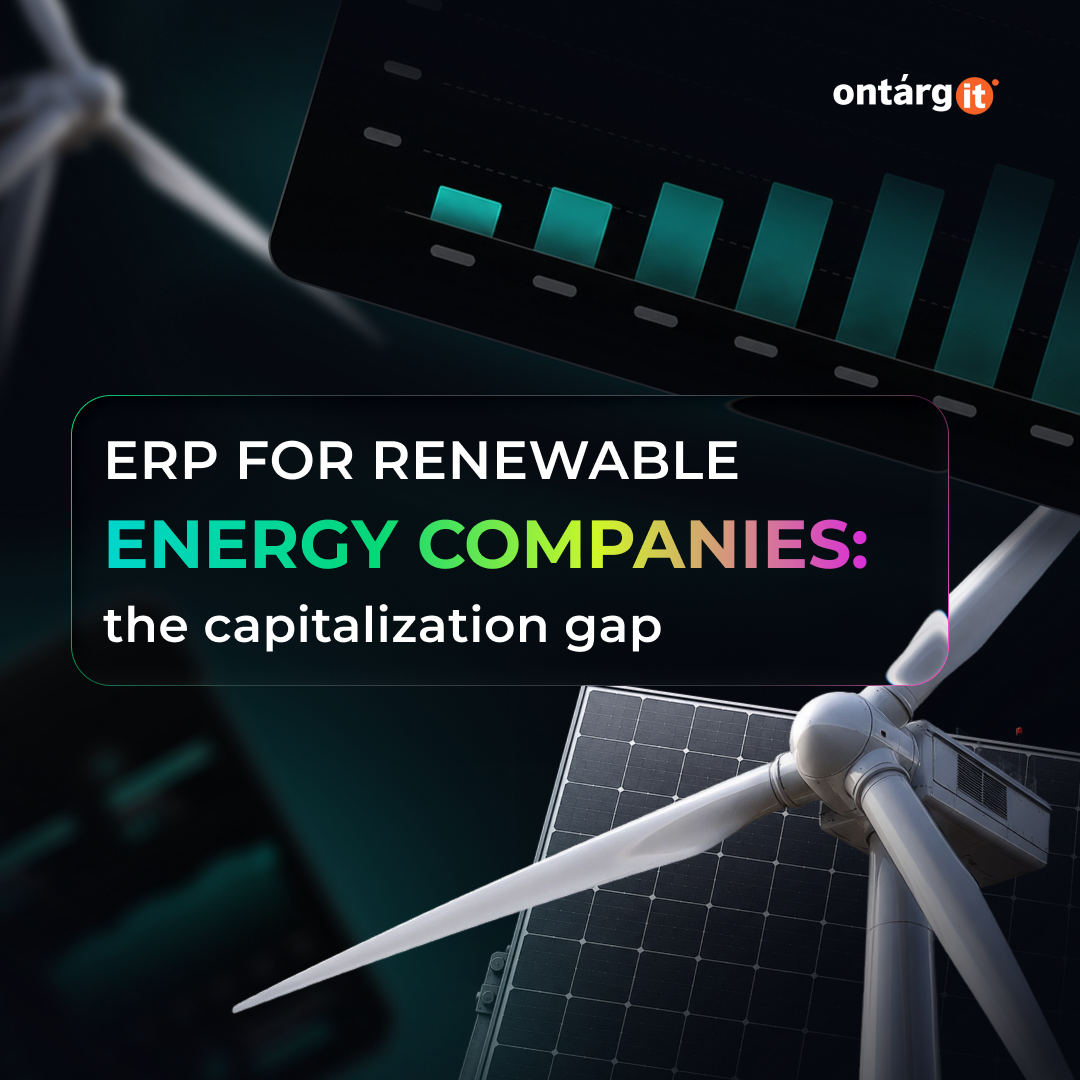
Norway commissioned 18 wind farms in a single year. That was 2020, and against a 25-year operating life those turbines now sit closer to their first major component replacements than to their commissioning date. The systems tracking them were built for construction: budget variance, contractor invoices, drawdown schedules. Few were ever asked what one turbine has cost since it started turning. Choosing an ERP for renewable energy companies comes down largely to what happens at that boundary — how development cost becomes an asset, and what carries that asset’s cost for the next two decades.
The handover that breaks first
Norwegian onshore wind went up fast. In 2020 alone, 18 wind farms were commissioned with a combined 5.3 TWh of expected annual output, and by the start of 2025 the country had 65 wind farms running 1,392 turbines for 5,082 MW of installed capacity. Against the 25-year operating life NREL assumes for its reference wind project, much of that fleet is now between five and eleven years old.
That is the age at which the finance question changes. During development, cost sits in a project ledger and the reporting question is budget variance. Once the asset is in service, the same cost has to sit on an asset record that carries depreciation and absorbs maintenance spend for two more decades. Most groups rebuild that join by hand. It works once — and it does not survive year twelve, when someone asks what one specific turbine has cost since commissioning.
How investment projects hold cost before the asset exists
The mechanism sits in Project management and accounting, the project module inside Dynamics 365 Finance. An investment project tracks costs for items, time and expenses as work in progress rather than posting them to profit and loss, which is what makes it suitable for internal capital initiatives such as infrastructure development and asset creation. During construction, finance gets a running capitalizable total per project long before any asset record exists.
Project groups, categories and line properties determine how each transaction posts — internal projects generate no revenue, but their costs can be capitalized. Configure those wrong and nothing looks broken until capitalization, when the value landing on the asset is not the value the project consumed.
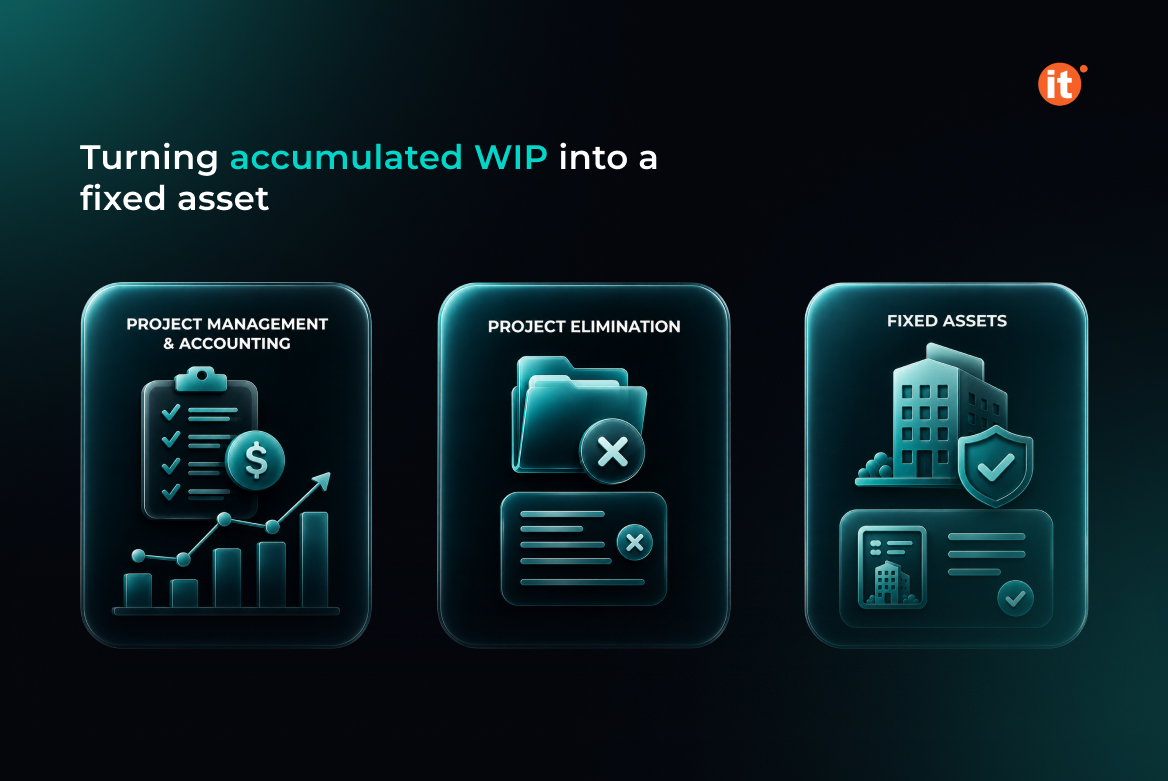
Turning accumulated WIP into a fixed asset
At completion the organization chooses between two paths: eliminate the project to generate a fixed asset, or transfer the WIP costs to another ledger account. Elimination moves accumulated WIP to the appropriate ledger accounts and acquires the fixed asset associated with the investment project.
Capitalization becomes a posting event with a voucher behind it — auditable, reversible, repeatable across every project company in the group. Controllers who have closed a year on a hand-built capitalization schedule will recognize what that removes: the annual argument over which construction invoices belong to which turbine.
Where the operating phase actually lives
Asset Management is a module of Dynamics 365 Supply Chain Management for managing assets and maintenance jobs on equipment a company operates itself.
Functional locations are hierarchical, with sublocations, and asset costs follow the asset’s location: install an asset at a new functional location and it automatically picks up that location’s financial dimensions. A site-to-turbine-to-component hierarchy therefore produces per-asset cost tracking as a by-product of the structure rather than as a reporting project. One warning worth heeding at design stage — the structure is static, and a functional location cannot be moved once created.
Maintenance scheduling runs off that structure. Maintenance plans apply to individual assets and maintenance rounds to groups; both generate work order proposals that become maintenance schedule lines and convert to work orders. Plan lines can be time-based or counter-based — triggering every 250 operating hours, say, or when a wear measurement drops below a threshold.
Why the capex-opex boundary keeps mattering
A gearbox replacement is not routine maintenance. It is capital spend on an asset already in service, and this is where the two modules join. Fixed assets and Asset Management integrate directly: a maintenance asset can be created from an existing fixed asset, and Fixed assets users can view the costs posted from work orders against it. A work order type set to Investment creates a work order job project, and the Fixed asset number field is populated only when the project type is Investment. Major component work routes back to the asset instead of disappearing into an opex bucket.
That distinction also settles the Field Service question. Microsoft documents Dynamics 365 Field Service for delivering onsite service at customer locations — useful if you service third-party assets under contract, but a wind farm you own is not a customer location. For an owned fleet, Asset Management is the documented fit.
Decide the deployment type before the rollout starts
Microsoft names three Project Operations deployment types — Project Operations Core, Project Operations Integrated with ERP, and Project Operations for manufacturing — and describes the underlying scenarios as stocked/production order and non-stocked/resource-based, which can coexist in one environment through legal-entity-level configuration. Investment-project accounting requires the ERP-integrated path. Microsoft also states there is no out-of-box migration of data between deployment types; moving later needs custom scripts, custom mapping and potentially manual intervention.
So this is a decision to settle before the first legal entity goes live. OntargIT works in the energy and public sector vertical and runs parallel rollouts across jurisdictions — 150+ projects for 140+ clients in 24 countries, delivered by 100+ specialists in nine.
Conclusion
The capitalization event is the design decision that determines everything downstream. Get the investment project structure and the functional location hierarchy right before the first asset goes into service, and per-turbine cost history accumulates on its own for the next two decades. Get it wrong and you rebuild it by hand every year. Test your current setup against one question: can you produce the full cost of a single turbine since commissioning, without opening a spreadsheet? If not, the gap is structural, and it widens with fleet age.