


Microsoft Dynamics 365 Sales is the CRM application organizations use to manage pipeline, track opportunities, and give sellers one place to work from. On 11 August 2026, Microsoft announced that Gartner had again placed it in the Leaders quadrant of the Magic Quadrant for CRM Sales Platforms. That makes sixteen consecutive years.
What Gartner assessed
The 2026 Magic Quadrant for CRM Sales Platforms was published on 6 August 2026. Gartner notes that Microsoft helps sales teams improve pipeline visibility and seller productivity through AI-driven research, analytics, and workflow automation.
Dynamics 365 Customer Experience sets the placement against a shift in what buyers now evaluate. Record-keeping is assumed. The question has moved to how well a platform supports research, prioritization, and execution across the sales cycle.
Microsoft’s CRM products have been recognized as a Leader since 2011, and in 2017 Gartner combined its evaluation of those products into a single Microsoft Dynamics 365 for Sales assessment.
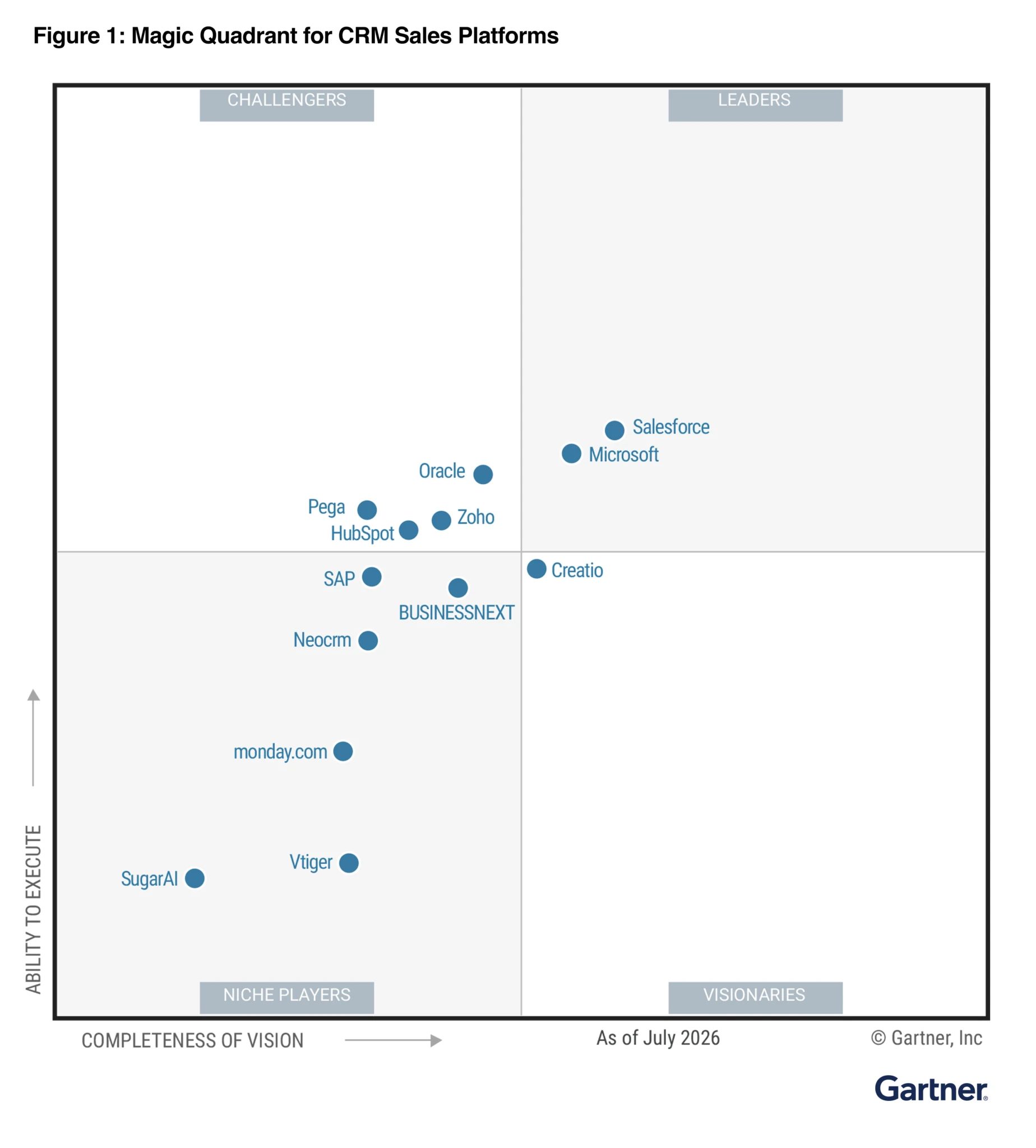
Gartner, Magic Quadrant for CRM Sales Platforms
The constraint sellers actually face
Sellers have more context than ever — customer conversations, CRM records, meetings, email threads, service interactions, market signals. Microsoft’s argument is that volume is not the bottleneck. Interpretation is.
Time spent researching accounts, assembling context, updating records, and coordinating next steps is time not spent with the customer. Buyers, meanwhile, expect faster responses and more personalized engagement on every touchpoint. Sales leaders face the same problem one level up: pipeline health and risk are hard to read when the underlying data is stale or scattered across systems.
The agents behind the claim
Microsoft names four in the announcement. Sales Research Agent, Data Enrichment Agent, and Sales Agent work to keep customer and opportunity records current. Sales Qualification Agent supports sellers as they research, engage, and qualify leads.
Sales Agent also runs inside Microsoft 365 Copilot, where it handles meeting preparation, record summaries, follow-up assistance, and sales insights across Dynamics 365, Outlook, and Teams. The practical effect is that a seller can act on CRM data from the applications they already have open.
Where packaged agents do not fit the process, Microsoft points to Copilot Studio and Microsoft Power Platform for building custom agents that connect systems and automate workflows — subject, as Microsoft states, to customer configuration, governance, and the product capabilities in place.
Conclusion
Sixteen Leader placements describe consistency, not direction. What the 2026 announcement actually signals is a change in where CRM work happens: the agent roster now researches, enriches, and qualifies against records on its own schedule, and the seller meets the result inside Outlook or Teams rather than inside the CRM. For implementation teams, that moves the design conversation from field layout and form logic to agent scope, data quality, and governance — decisions that determine whether an agent can be trusted to act unattended.