
Dynamics 365 Sales has always given teams a record of what customers did. It rarely tells them what to do next. That gap — a system built to log activity rather than act on it — has quietly shaped how sales teams spend their week: updating fields, digging through email threads for context, and manually stitching together next steps instead of talking to customers. Microsoft’s newest direction for CRM, described as “agentic CRM,” is designed to close that gap by having AI agents handle the recording so people can focus on selling.
The cost of a CRM that only looks backward
Sellers report spending large portions of their week on activities that could be automated or delegated, leaving only a small fraction of time for the direct customer engagement that actually moves deals. Buyers, meanwhile, increasingly expect sellers to stay engaged throughout the middle of the buying process — not just at the open and close. When CRM data lags behind reality, forecasts become guesswork, and trust with the customer erodes before a deal is even at risk.
What changes with agentic CRM
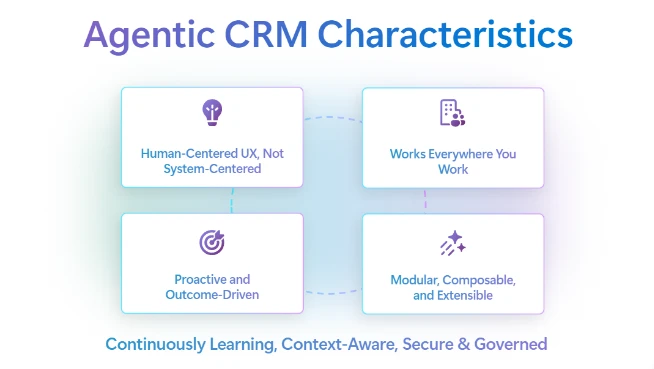
Agentic CRM shifts the system from passive record-keeping to active support. Five traits define it:
Where this shows up for admins and implementation teams
Microsoft's photo
For organizations running Dynamics 365 Sales, three familiar pain points map directly onto this shift. Time lost to non-selling work is addressed by a set of specialized agents that handle pipeline generation, opportunity progression, and account research in the background. Fragmented workflows — often spread across a dozen disconnected tools — are addressed by bringing CRM data directly into Outlook, Teams, and related apps, rather than asking sellers to switch systems. And the long-standing adoption problem, where records go stale because manual entry is tedious, is addressed by automatic data enrichment: agents capture signals from email and meetings, update the record, and feed better data back into the next recommendation.
Early results from live deployments
Organizations already running agentic CRM report tangible movement. One global technology manufacturer credits it with helping sellers understand account context and prepare for meetings without leaving their workflow. An agricultural equipment dealer used an AI-driven sales development agent to generate qualified leads across multiple divisions within weeks of a limited rollout. Microsoft’s own sales organization, comparing sellers with high Copilot adoption and agents with low-usage peers, reports meaningfully higher deal closure rates, stronger lead-to-opportunity conversion, and higher revenue per seller.
Conclusion
For CROs and CSOs evaluating a CRM refresh, the calculation is shifting from “which system stores our data best” to “which system helps our sellers act on it fastest.” Agentic CRM points toward a model where the platform itself narrows the distance between a customer signal and a seller’s next move — turning the CRM from an archive sellers update into a system that updates itself and hands sellers the next step.