
As organizations increasingly integrate AI into their daily operations, the bottleneck has shifted from data collection to data accessibility. Traditional integrations often require complex, custom-coded pipelines to help LLMs understand enterprise data.
The key to unlocking this data lies in simplifying the conversation between the AI and the database—that’s where MCP is needed.
How MCP and BPA Unified ERP Data
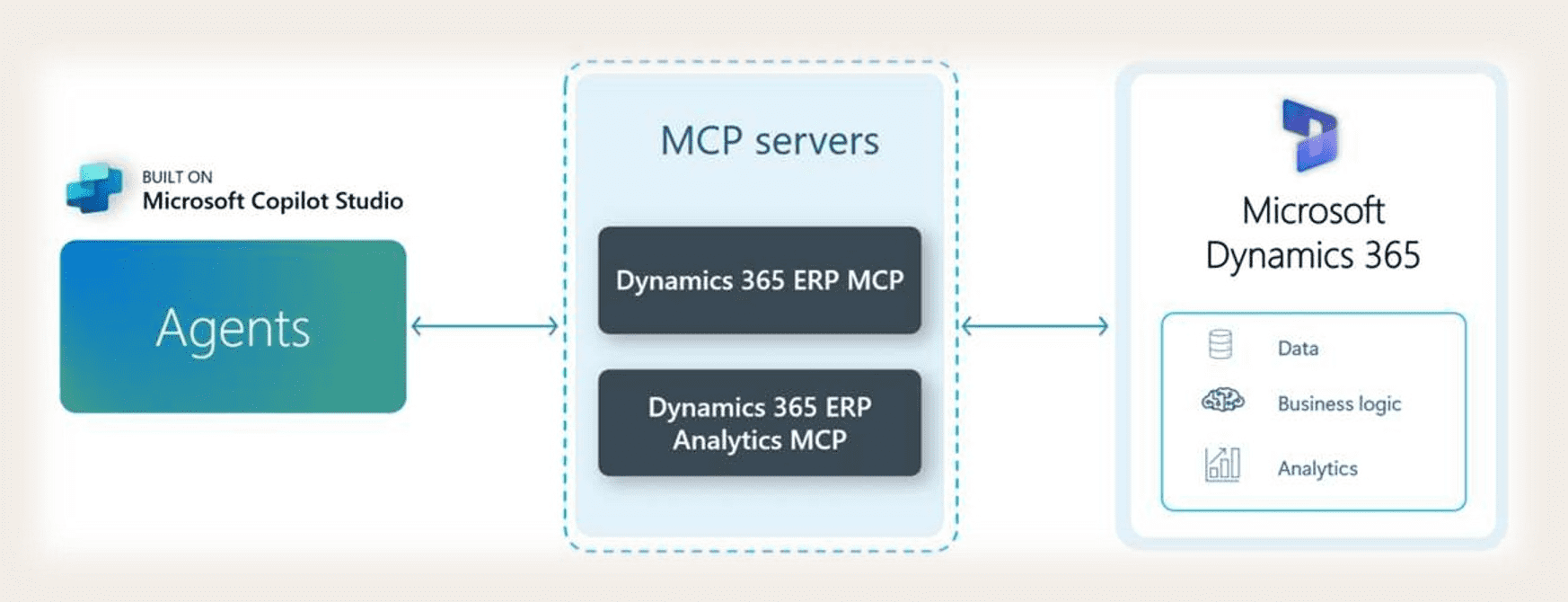
The Model Context Protocol (MCP) is an open standard designed to harmonize how applications provide relevant context to Large Language Models. MCP allows AI models interface directly with Dynamics 365 data without the need for bespoke, custom-coded integrations. By acting as a standardized abstraction layer, the MCP server empowers two types of workflows: user-led analysis, where people use familiar tools like Excel and Power BI, and autonomous analysis, where Copilot agents proactively monitor and interpret data on the user’s behalf.
At its core, this technology is connected to Business Performance Analytics (BPA). BPA functions as a centralized analytical store for Dynamics 365 ERP data, transforming raw records into a structured analytical schema that is significantly easier to query and interpret than traditional transactional systems.
Key benefits include:
Picture from Microsoft
The Technical Framework in Motion
Translating this theoretical framework into action requires a specific set of technical capabilities that allow the AI to interact with the data model in real-time.
The technical framework of the ERP Analytics MCP is currently defined by two primary tools that the AI utilizes to perform tasks.
The first is “get-bpa-dataset-schema,” which allows the AI agent to “read the map” of the database, understanding which tables, measures, and entities are available for analysis.
The second is “execute-dax-query,” which gives the AI the ability to actually write and run queries to extract specific data points. The tool automatically applies Row-Level Security (RLS).
Permission Inheritance and Human Oversight
Ensuring that AI does not overstep its bounds is a critical component of the ERP Analytics MCP. The system relies on Microsoft Entra ID for enterprise-grade identity management and authentication. Crucially, the MCP server inherits existing permissions from the BPA environment. Furthermore, developers have the flexibility to implement “Human-in-the-Loop” safeguards, requiring an actual person to review and approve sensitive actions before the AI executes them.
Summary
The Model Context Protocol represents more than just a technical bridge; it is a fundamental shift in how we interact with enterprise resource planning. By leveraging the structured power of Business Performance Analytics and the precision of tools like DAX Query execution, the MCP server effectively solves the “last mile” of data analysis. It replaces manual dashboard navigation with intuitive, AI-driven insights—all while maintaining the rigorous security standards of Microsoft Entra ID and “Human-in-the-Loop” oversight. As this protocol continues to evolve, the barrier between complex ERP records and actionable intelligence will continue to vanish, allowing businesses to focus less on querying their data and more on acting upon it.